Interacting with AI Systems
As mentioned in the Introduction, AI models alone won't allow us to cram AI features into every corner of our digital life. The primary focus of an AI model is to implement the core mathematical algorithm of an AI system. But a typical AI system usually contains other components that enable all kinds of software to interact with the AI system in a streamlined way. Such components are what we are going to discuss in this part of the course.
We will largely focus on the industry standard technique for streamlined interaction between software, called the application programming interface (API). In Module A.1 we will establish concepts essential for the discussion around APIs. We will also have the chance to play with the API for an existing AI system. In Module A.2 we will learn how to integrate API interaction in the programming language that you are most familiar with, in this case Python, so you can easily incorporate AI functionalities into your programs.
Then we move from being consumers who rely on existing APIs to implementing our own so we can become producers. In Module A.3 we will learn that the APIs we interact with in the previous two modules are also a type of software called an API server. We can also implement one ourselves using an API server framework, with FastAPI being the prime example. In Module A.4 we will go a bit deeper and integrate AI models into our API servers.
In the end, we will be capable of implementing a system with AI functionalities powered by AI models, while allowing streamlined interaction from various types of software on the market. In other words, a system we can confidently call an AI system, fully featured and ready to be deployed in the real world to inflate the AI bubble even more.
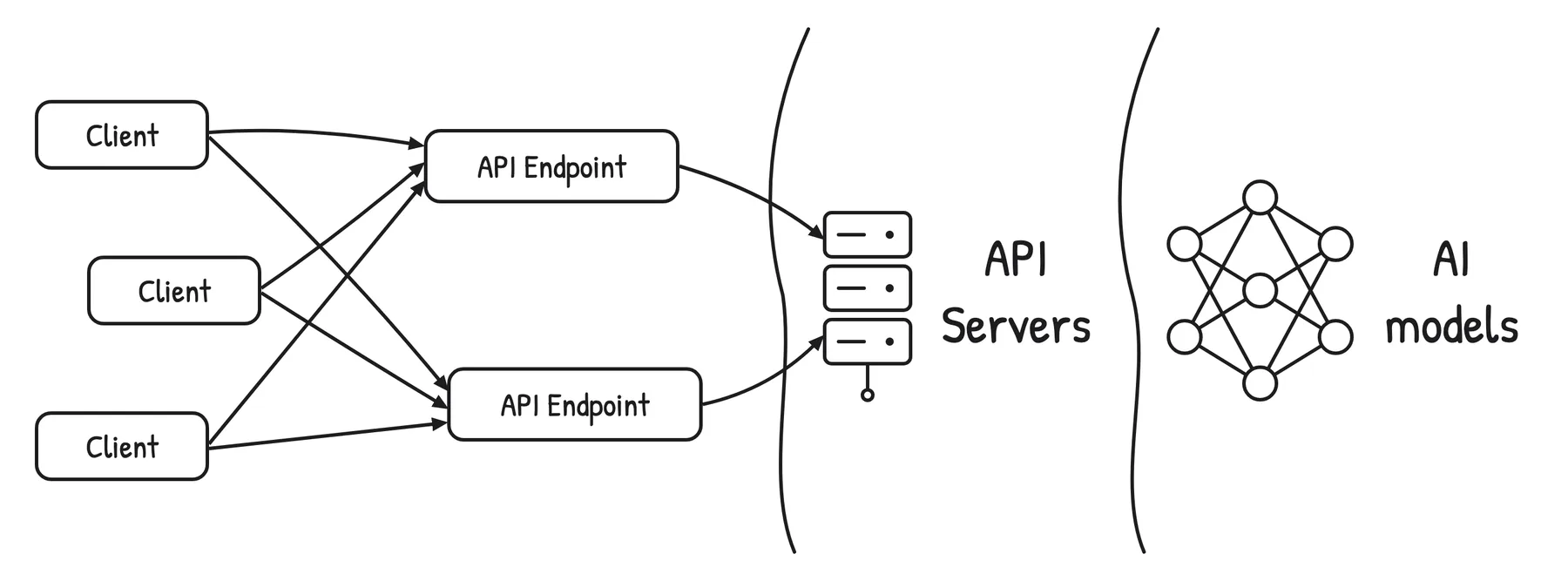
Clients reach AI models through API endpoints exposed by API servers.